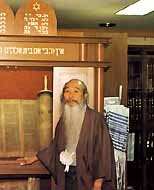
The Japanese-Jewish Connection
Though I have never heard of this theory before, it has apparently been around for quite some time. I only heard of the Japanese-Jewish connection today, when I read a blog post titled “Are The Japanese Actually Jewish? Looking at the mysterious connections between Japan and Judaism.â€
In this post, similarities between the two cultures are presented. The theory is that due to the never ending warfare in Israel, the tribes dispersed all over the world AND some of them found their way to Japan. So what are these connections?
For example, the Japanese Shintoist Holy day is the Yamaboko Junko, or “Going atop the Mountain to lay to rest the Shrine”. The day Noah’s Ark rested atop Mount Ararat lies on the same day. The word “Essa”, which is a carrying chant chanted by the holders of the Omikoshi, or portable shrine, is a word which really has no meaning in Japanese but means “Carry” in Hebrew.
Here is another one:
One of Japan’s largest festivals, the Gion Festival, is believed by many, including the Gion Festival officials, to be the same as Ancient Israel’s Zion Festival. The month long festival is almost identical in each event, date, etc. The artwork depicted on the portable shrines in the festival are from ancient Japan, but are renderings of landscapes in the middle east – camels walking the desert, pyramids, Baghdad Palaces, and most surprising is a grand picture of Rebecca offering water to Isaac which is confirmed to be a rendition of Genesis 24 in the Old Testament.
Japan and Judaism are the last things that I would pair up in my mind – but that only goes to show how much I have to learn. Have you heard anything about this connection?
Do you like this article? Submit it to Blogosphere News!
Posted September 21st, 2008 by Maki | Comments (7)7 Responses to “The Japanese-Jewish Connection”
Leave a Reply


During my days living in Ise-shi, I seem to remember hearing something about the sacred mirror inside of the Ise Jingu grand shrine. It was said that there’s Hebrew written on the back of it but, unfortunately, only the emperor can take it out of its bag so we’ll likely never get to see it.
I’m gonna go out on a limb and say that it’s not true, but I challenge the emperor to make me eat my words!
[...] actually Jewish? – Looking at the mysterious connections between Japan and Judaism (Oniazuma) The Japanese-Jewish Connection [...]
First off the original Jews who are believed to have come to Japan were Jews of the Lost Tribes. These Jews had been exiled and had they traveled east would have traveled roughly along the Silk Road. How they got all the way to Japan is somewhat unclear, but it should be noted there are many aboriginal tribes in Japan which were there before the original Chinese settlers.
Other things that are similar are the traditional Japanese uses of salt, ceremonies performed on a new baby (bay leaves for purification, etc.) and traditional Temple design. Also, pots and things recovered from archeological sights have been found to have traditional Jewish designs and some pieces have been found with Hebrew-esque writing.
You may also want to know there is a group for Japanese people who believe this theory, called the Makoya. I’m not personally one of them, but my grandparents are (which is why I have heard all this)..
Interesting. Now this is something I’ve never heard of before. I wonder if the Jews have also reached other parts of Asia besides Japan during those days?
There is an easy way to test for this. Certain genetic markers common to Jewish people could be found in the general Japanese population, thus confirming this possible immigration of the early Jews to Japan. This was done for a group of Africans who claimed to be a lost tribe of Israel. The markers were there, confirming their claims!
Genetics is awesome!
Dear Zero — Re the claim that both the Jews and the Japanese have “ceremonies performed on a new baby” that use “bay leaves for purification, etc.” — no, we Jews don’t have such ceremonies. Someone has misinformed your grandparents.
Will manage somehow.