Hiroshima Remembered
The younger generation may not remember Hiroshima and what occurred there decades ago but those of us who are old enough to remember would know the significance of this place. On the 6th of August 63 years ago, this southwestern Japanese city was bombed by the United States. The atomic bomb brought on a disaster that lasted for many years after.
Today, Japanese Prime Minister Yasuo Fukuda attended a memorial ceremony to remember those that perished and suffered due to the bombing. Though it has been more than half a century since then, we cannot afford to forget what happened. It is a lesson that all people of the world should learn.
As such, Hiroshima mayor Tadatoshi Akiba is calling for the support of the United States on a proposed ban on nuclear weapons. According to the Associated Press:
Hiroshima’s mayor on Wednesday urged the next U.S. president to support a proposed ban on nuclear weapons, as Japan marked the 63rd anniversary of the atomic blast that obliterated this city and killed 140,000 people.
In a ceremony, Hiroshima Mayor Tadatoshi Akiba also announced the launch of a two-year study to gauge the psychological toll of the Aug. 6, 1945, attack in the closing days of World War II.
Japan submitted a resolution in the U.N. last year calling for the abolition of nuclear weapons. Akiba said that 170 nations supported the resolution, while the U.S. was one of only three countries to oppose it.“We can only hope that the U.S. president elected this November will listen conscientiously to the majority,” Akiba told a crowd of 45,000 gathered beneath at the spot where the bomb detonated.
A moment of silence was observed at 8:15 a.m., the time of the blast. An estimated 140,000 people were killed instantly or died within a few months after the bombing. Japan’s official death toll of nearly 260,000 includes injured who have died in the decades since.
Regrets have been expressed. Ideologies have changed. Hopefully, something like this would never happen again.
Posted August 6th, 2008 by Maki | Comment (1)
Wingtip: Segway Killer
Toyota Motor of Japan announced a new gadget yesterday and it is said to be the Segway killer. The Segway was introduced some years ago and has become a popular means of transporting one’s self around easily.
The Winglet, as the new electronic scooter is called, can be controlled by shifting your body weight. By doing so, the rider can go forward, backward, and turn left or right.
So just how fast can the Winglet go? A smooth 6 kilometers per hour. I don’t know if people like me would like to go that fast, though. What I like about the Winglet is its cool design, as compared to the Segway.
Wired.com gives more information on the Winglet:
Called the Winglet because of its fleet nature, it is the first gadget to duplicate the celebrated, and often mocked, navigation system of Dean Kamen’s Segway Transporter: self-balancing through gyroscopic sensors detecting the gentle directional tilts of a rider.
According to Toyota, they will begin testing three different models at a few Japanese airports later this year, as well as some popular malls. The feedback received from customers will help determine whether Toyota will mass-market the gadget for sales everywhere else.
Come to think of it, though, the Winglet would not stand a chance if it were to be pitted against the Segway in a race. The Segway looks sturdier and IS probably sturdier. So why do they call it the Segway killer? I honestly don’t know – perhaps it has more features. Has anyone tried this?
Posted August 2nd, 2008 by Maki | Comment (0)
Making Music With The Koto
The Japanese culture is rife with musical influences. Indeed, one of the richest aspects of their culture is their music. Though not everyone may be familiar with the terms and technical aspects of Japanese music, I am sure that many are at least familiar with the looks and sounds of their instruments.
One of the most important of the Japanese traditional musical instruments is the koto. The koto is a traditional string instrument which actually has its roots in the Chinese zither. In fact, the koto is considered to be the national instrument of Japan.
What are the origins of the koto? According to one legend, this instrument was formed in the shape of a dragon, which we know is a mythical creature held in reverence in the east. On the more practical side, though, the koto was introduced to Japan by traveling Chinese and Korean musicians in the 7th century. In the beginning, the koto was only used for royal audiences but by the 15th century, it was widely used to entertain the common people as well.
The koto has 13 strings, all of which are stretched along the length of the soundboard, which is about 2 meters long. The soundboard is made of wood while the strings are made of synthetic material (these days, at least). In the old days, the strings were made of silk. The strings are tuned by bridges which can be moved, made of ivory or plastic.
Today, the koto is still used to play music and many music schools in fact offer classes on how to play the koto.
Photo courtesy of Marshall Astor
Posted July 28th, 2008 by Maki | Comment (0)
63 Japanese Set For Space Burial

At the end of this month, 63 Japanese will be “buried” in space. The ceremonial burial is in fact going to include people from all over the world. This service is provided by Celestis, Inc, a company from the United States.
Celestis has been providing this service since 1997. According to a spokesman, since the space burial service was launched, the Japanese has become their second most numerous customers, the first being Americans. So what exactly is a space burial anyway?
The first step is for the deceased to be cremated here on Earth. The ashes which result from the cremation are then placed into capsules – or rather, a small amount of the ashes. The capsules range from 1 gram to 14 grams, depending on the person. The capsules containing the ashes of the deceased are the placed in a satellite, which will eventually be launched into space. Once launched, the satellite will be orbiting the Earth for several years, after which it will burn out in space.
How much will a space burial set you back? Celestis advertises different services in their web site and based on the information given there, you can spend anywhere from USD695 to USD12,500. The services range from Earth Rise Service, Earth Orbit Service, Luna Service, and Voyager Service, respectively.
For more information – whether you are merely curious or you want to make plans for your future – visit the Celestis web site.
Posted July 26th, 2008 by Maki | Comment (1)
Gake no Ue no Ponyo

Anime lovers will be thrilled to know that there is another big anime movie that has just been released. Gake no Ue no Ponyo, which is literally translated to English as Ponyo on the Cliff, is the brainchild of Hayao Mizayaki.
Hayao Mizayaki is not a stranger to anime fans. In fact, he is considered to be the king of Japanese anime. With his countless successful works, this is not a surprise. Just to name a few of his creations:
• Majo no Takkyubin (Kiki’s Delivery Service)
• Sen to Chihiro no Kamikakushi (Spirited Away)
• Mononoke Hime (Princess Mononoke)
• Howl no Ugoku Shiro (Howl’s Moving Castle)
• Tonari no Totoro (My Neighbor Totoro)
His latest, Gake no Ue no Ponyo, is no less than a hit as well. With more than 1.25 million people watching it on its opening weekend, the movie earned almost 1.6 billion yen!
So what is this about? The Japan Times narrates:
The title character, Ponyo (voice by Yuria Nara), is a girl fish with a human face who decides one day to leave her underwater home — and her school of smaller sisters — to see what lies on the surface. Riding on the back of a jellyfish, she is nearly trapped by a drift net, but escapes — with her head stuck in a glass jar. Sosuke (Hiroki Doi), a boy who lives on a house on a seaside cliff, spots Ponyo in the shallows and rescues her. He is delighted with his new pet — and Ponyo is delighted to be in the human world at last. She says her first words, to Sosuke’s astonishment — and begins a transformation from half-fish to human.
I’ll stop there in case you haven’t watched it yet. My question is: when will this be released in other countries?
Posted July 23rd, 2008 by Maki | Comment (1)
For Expecting Mothers Only

As if carrying a child inside one’s self is not hard enough already, pregnant women can actually encounter difficulties when availing of other services – well, at least in Japan. Come to think of it, though, not all establishments are equipped with pregnant women-friendly services. That is why Ryoko Tsukuda thought of creating the “Maternity Plan,” which is a program geared towards making life comfortable for those who are with child.
Her brainchild is the product of a personal experience. When she was pregnant, she tried to make reservations at a hot spring resort for herself and her mother. However, when the management found out that she was pregnant, she was informed that she could not use the common bath. As she was working for Kinki Nippon Tourist Co, she thought of coming up with a travel plan for mothers-to-be like herself. Her company bought the idea easily and launched the program February of last year.
What Ryoko Tsukuda did was to visit inns, hotels, and other establishments that have facilities that are suitable for pregnant women. To date, the travel plan is experiencing continued success.
There are also other establishments like Hiromaru Taxi Co which cater to pregnant women. In April of this year, they launched a program called Jintsu 119. The idea is to have women register their home address and hospital in advance. When the time comes to give birth, a taxi will be sent immediately to take the woman to the hospital.
Interesting concepts, don’t you think?
Photo courtesy of Robert Whitlock
Posted July 19th, 2008 by Maki | Comment (0)
Women Getting Back Into The Rat Race

In some cultures, women are expected to quit working once they get married and start a family. Though Japan is not unique in this respect, the figures involved are probably significantly higher. According to a report in Japan Today, the estimated figure is about 70 percent. That is, this is the percentage of working women who quit their jobs when they get married.
The report states:
In Japan, about 70% of working women quit their jobs when they start a family. Though many hope to eventually return to the workplace, it is difficult for them to return to a full-time working environment afterwards. According to the government, approximately 2.45 million women aged between 25 and 65 wish to work full-time in companies.
As one of the measures to encourage women to return to the workforce, Japan Women’s University (JWU) started the so-called “Recurrent Education-Employment System” with the government’s financial support in September, 2007. In the one-year program, women who have bachelor degrees and working experience take courses to update their work skills, such as business English and introductory and advanced computer training. The program also provides career counseling so students can find new jobs which match their related experience and skills.
This is good news for the large number of women who may have been forced by the circumstances to give up what they have worked long and hard for. Aside from having the chance to continue what they started before they got married, these women would be able to help out with the family finances. With the way things are going in world economics today, this is something that a lot of people would welcome for sure.
Posted July 17th, 2008 by Maki | Comments (2)
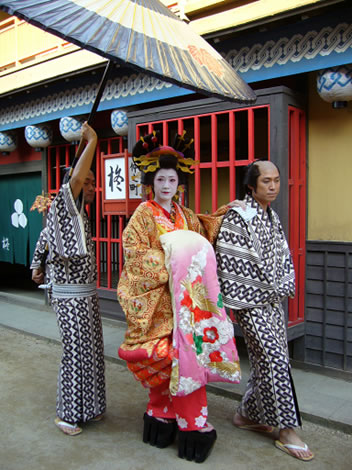
The Life Of A Geisha Girl

I was watching cable television the other day when I saw this program about a young girl who left school to train to become a geisha. I do know that geishas still exist in modern day Japan but I haven’t really paid attention. That is, until I watched this documentary created by BBC Four.
The documentary is all about a 15-year old girl named Yukina. She left school and her family in order to train as a maiko. This is the Japanese term for an apprentice geisha. Did you know that in Japan, 15 is the minimum age required for girls in order for them to train as a maiko?
So there she was, practically a pariah in the eyes of her family and her friends. You see, Yukina has always dreamed of becoming a geisha. Her parents and friends didn’t seem to approve of her decision to drop out of school and go to Kyoto to train, though.
The documentary showcases her journey as she trains to become a maiko under the Okasan, or geisha mother. I found the whole show captivating as it showed a whole new light to what a geisha is and what a geisha does. It also highlighted some facts that I never knew about. For example, did you know that a geisha’s kimono costs thousands of pounds? More so, a geisha has to have about 7 of them in her wardrobe!
If you have not seen this documentary, visit Veoh, where I saw an online version.
Posted July 15th, 2008 by Maki | Comment (0)
Hakone Kowakien Yunessun Spa

Do you love wine and other similar drinks that contain alcohol? Do you like relaxing in the great outdoors? Do you like hot springs? Do you like being pampered? If you answered yes to these questions, then I suggest trying out the Hakone Kowakien Yunessun Spa . This place is one of a kind. Located at the foot of Mt. Fuji, the spa offers a wonderful experience to suit all sorts of tastes.
They have over 25 water attractions which will definitely give visitors what they want. The main attraction is called The God’s Aegean Sea and it is “composed of three islands with relaxing spa waters. The God’s Aegean Sea also includes a variety of water massaging devices. Also, experience the wonder and drama of dynamic special effects by a fully illuminated water screen high above on the ceiling.”
What appeals more to me, though, is the Wine Spa. The Spa’s web site describes it as:
A unique spa containing real red wine. The huge wine bottle is 3.6m tall and is very remarkable. Bathing in wine is a rejuvenation treatment for the body, and it has been said that the Queen of Egypt, Cleopatra loved to bath in wine. There are regular performances of pouring real wine into the spa a few times a day.
Ok, I thought Cleopatra bathed in milk but oh well, a bath in wine is something that any wine-loving person should experience, don’t you think?
Another interesting feature is the Coffee Spa. Caffeine junkies should not miss out on this. Naturally, the bath is made of coffee in hot spring water. I think I shall spend some time dipping in wine and then wake myself up with a dip at the Coffee Spa.
Take your pick!
Posted July 9th, 2008 by Maki | Comment (0)
Martial Arts: Koryu

I am sure we all know about karate – thanks to the Karate Kid series of movies. We know about aikido – thanks to Steven Segal. We know a lot of Eastern martial arts. Yet have you ever heard of koryu?
Koryu is the Japanese word used to refer to the ancient Japanese martial arts. Trust me, this is the real thing! Basically, if you translate koryu to English, you will get “old school.” Now that sounds good, doesn’t it?
Koryu typically refers to the Japanese martial arts schools that focus on the techniques that existed way before the Meiji Restoration. That is, before the year 1866. As you can see, koryu is a very old Japanese tradition.
This term actually covers a lot of ground and even encompasses some of the better known schools of martial arts today. This includes judo and aikido. However, the latter two are modern day versions of koryu. More so, koryu includes both armed and unarmed fighting techniques.
To give you a more comprehensive background on koryu:
Although systematic training in the use of weapons, and methods for employing them in warfare existed long before, it is generally believed that the development of martial traditions, schools, or styles (ryu-ha) did not arise until after the end of the Heian period (794-1185). Central to this training was study of the bow (yumi), the sword (tachi), and the spear (yari). Initially, these weapons were not studied in separate arts. Rather, since the need was to prepare for battlefield combat, many different weapons and strategic and tactical skills were taught as part of comprehensive systems (sogo bujutsu). From the middle of the Muromachi period (ca. 1480) to the beginning of the Tokugawa period (ca. 1605) people gradually began to specialize in a particular weapon or system, particularly the bow, spear, sword, grappling and horsemanship. Warriors gathered in family-centered groups or trained with other members of their local domains. As the techniques and methods of these groups became more and more individuated, or as teachers gained particular insights into the essential nature and principles of combat, there arose discrete martial “traditions” or “styles” or “schools” (bujutsu ryu-ha). This began happening at the beginning of the Keicho era (ca. 1600), picked up impetus throughout the Tokugawa period (1600-1868), and has continued even into the twentieth century.
So are you interested in learning koryu? Are you thinking of training for koryu? I found a very informative and comprehensive site about koryu. Head on over there to find out more.
Photo courtesy of Meguro-jin
Posted July 7th, 2008 by Maki | Comment (1)